
One record. Five people who need it for different reasons
Finance wants losses and control failures out of the close checklist. Operations wants the same defect to stop coming back. Internal audit wants every finding to end in a verified action. Leadership wants to know what went wrong and what it cost. Firms want one place for every client. GlobalResolve is the same product for all of them.
Finance teams
Losses and control failures out of the close checklist and into a record you can sign
Most finance teams already have an incident log. It is a tab called “Issues” on the month-end workbook with three columns: what, who, status. It records that something happened. It cannot show that the fix worked, who checked, or what it cost across the year.
GlobalResolve keeps the two-minute logging and adds what the workbook cannot: a monetary impact per incident, an owner and date per action, verification by a second person, and a monthly report that totals it up. AP and AR log what they see first; the controller investigates; the CFO signs the report.
WHAT YOU SET UP IN THE FIRST WEEK
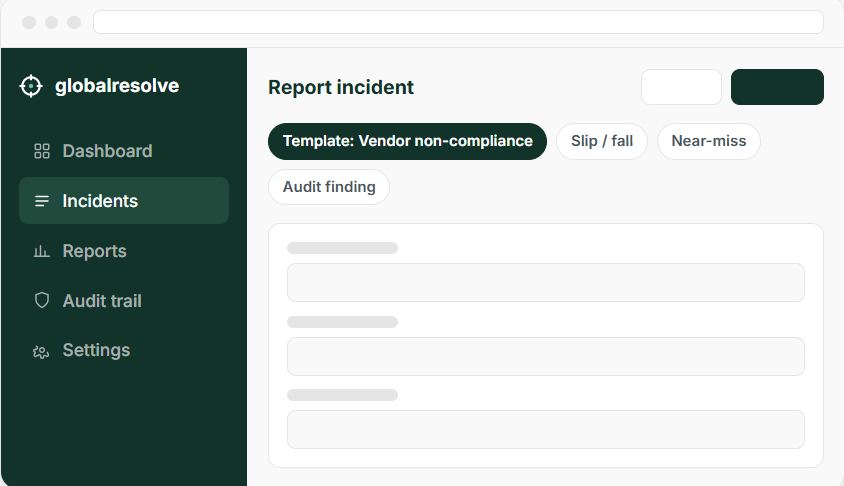
- Templates for your five most common issues. Most finance teams pick duplicate payment, late filing, reconciliation break, vendor non-performance and control failure.
- Your approval chain: who investigates, who verifies, who signs closure.
- The control report schedule: who gets it, which day of the month.
WHAT YOU GET
- A loss figure for the period, by category, with the incidents behind it.
- An answer to "what did you do about it" that does not depend on who is still employed.
- A monthly PDF the board reads in four minutes.
Operations leaders
The same defect, the same lost shipment, the same complaint: fixed once
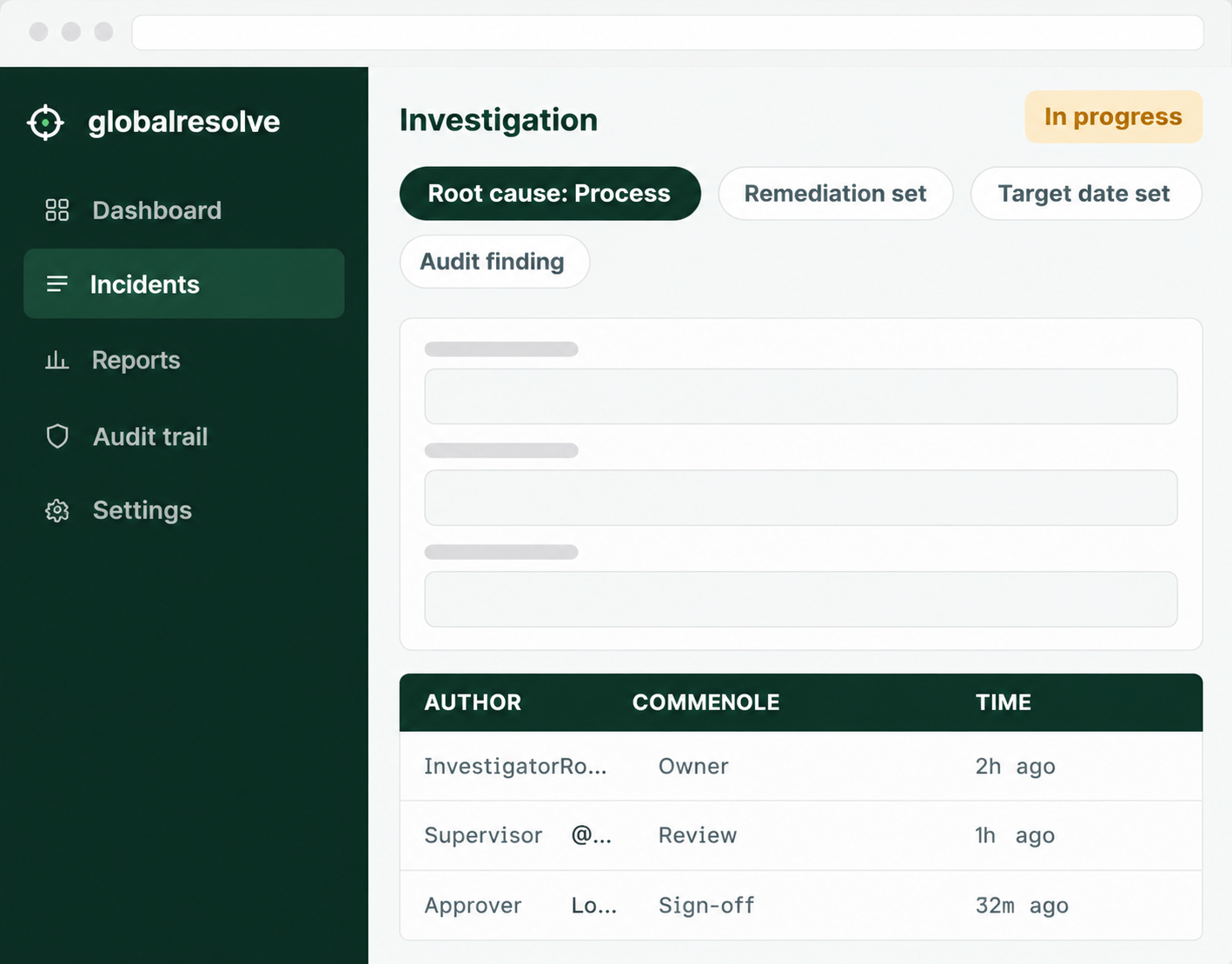
Operations teams already investigate. The shipment is traced, the batch is reworked, the customer is credited, the supplier is called. What is missing is the step after: the cause written down, a change to the process with an owner and a date, and someone checking a month later that the change held.
GlobalResolve gives production, quality, procurement, supply chain and customer service the same record finance uses, with the vocabulary they already have: incident, containment, root cause, corrective action, verification. A quality manager will recognize the cycle from ISO 9001 clause 10.2. A customer service lead will recognize it as the reason the same complaint stops arriving.
WHAT YOU SET UP IN THE FIRST WEEK
- Templates for your recurring failures: customer complaint, goods lost or damaged in transit, vendor non-performance, production defect or rework, near-miss.
- Categories by process or line, so the six-month trend shows where the failures cluster.
- Who verifies: usually the quality or operations lead, never the person who made the change.
WHAT YOU GET
- Cost of poor quality and operational loss by category, from the same monetary impact field finance uses.
- A verified corrective action record that satisfies a customer audit or a certification body.
- Fewer repeat incidents, visible in the trend, because the root cause was addressed rather than the symptom.
Internal audit and compliance
Every finding ends in a verified action, or it stays open
Audit findings go in as incidents with source set to “audit finding” and the finding reference attached. From there they run through the same cycle as any other issue: root cause, actions with owners, evidence, verification. The difference from a findings tracker is that the business owns the action and audit verifies it, with the division of roles set in the workflow rather than in a reminder email.
Compliance teams use the same path for regulator correspondence and policy breaches: source “regulator”, the reference number, and a record that shows the response was made, by whom, and checked.
BUILT FOR THE AUDIT COMMITTEE PACK
- The open actions register: overdue first, ageing, escalation level, by-owner concentration. Export to Excel with the filters stamped in the header.
- Due date history with mandatory reasons. Three extensions raises a flag you did not have to go looking for.
- Oversight role for committee members and external auditors: read-only access.
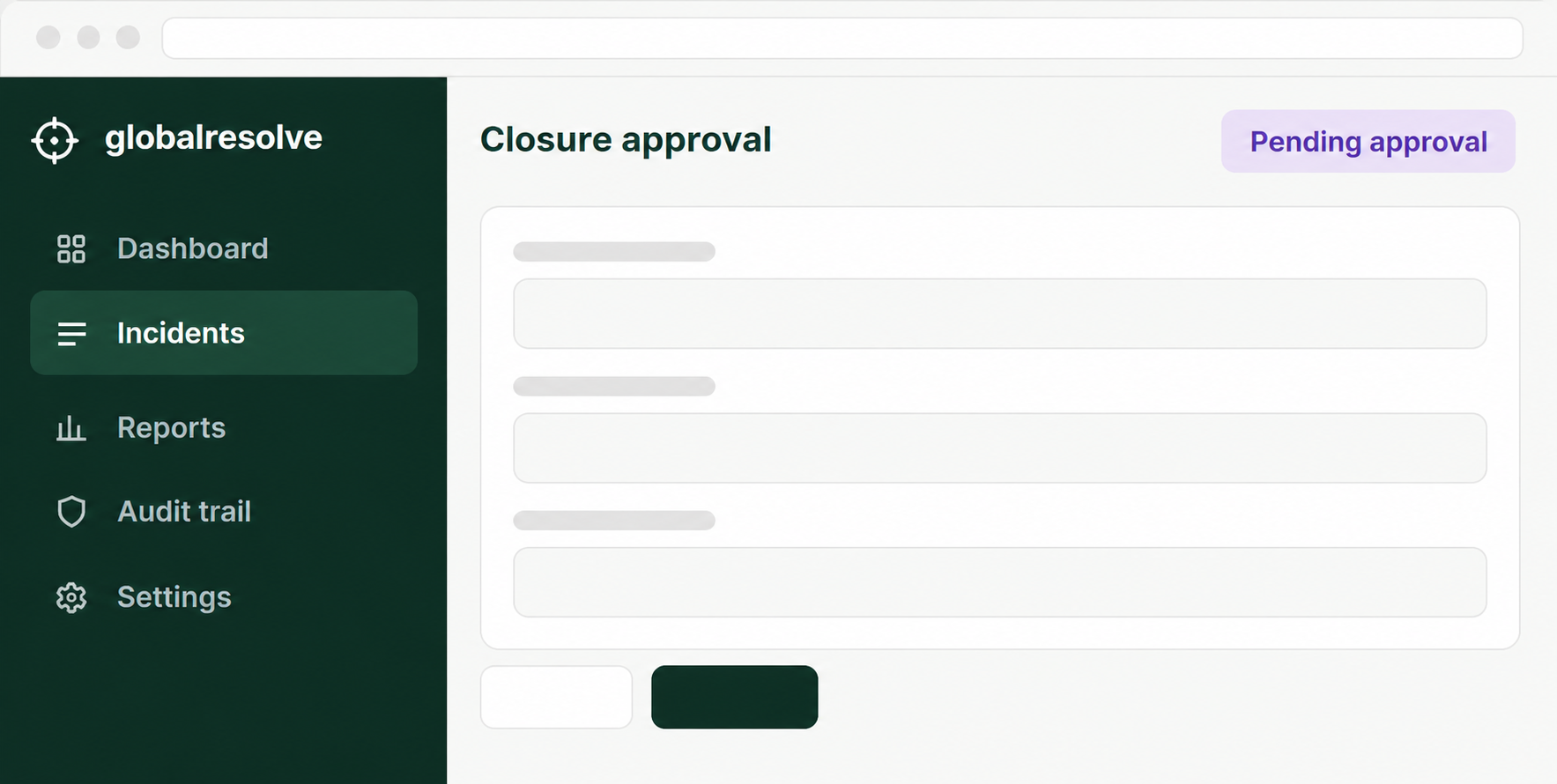
The Closure approval card, with approve and reject actions.
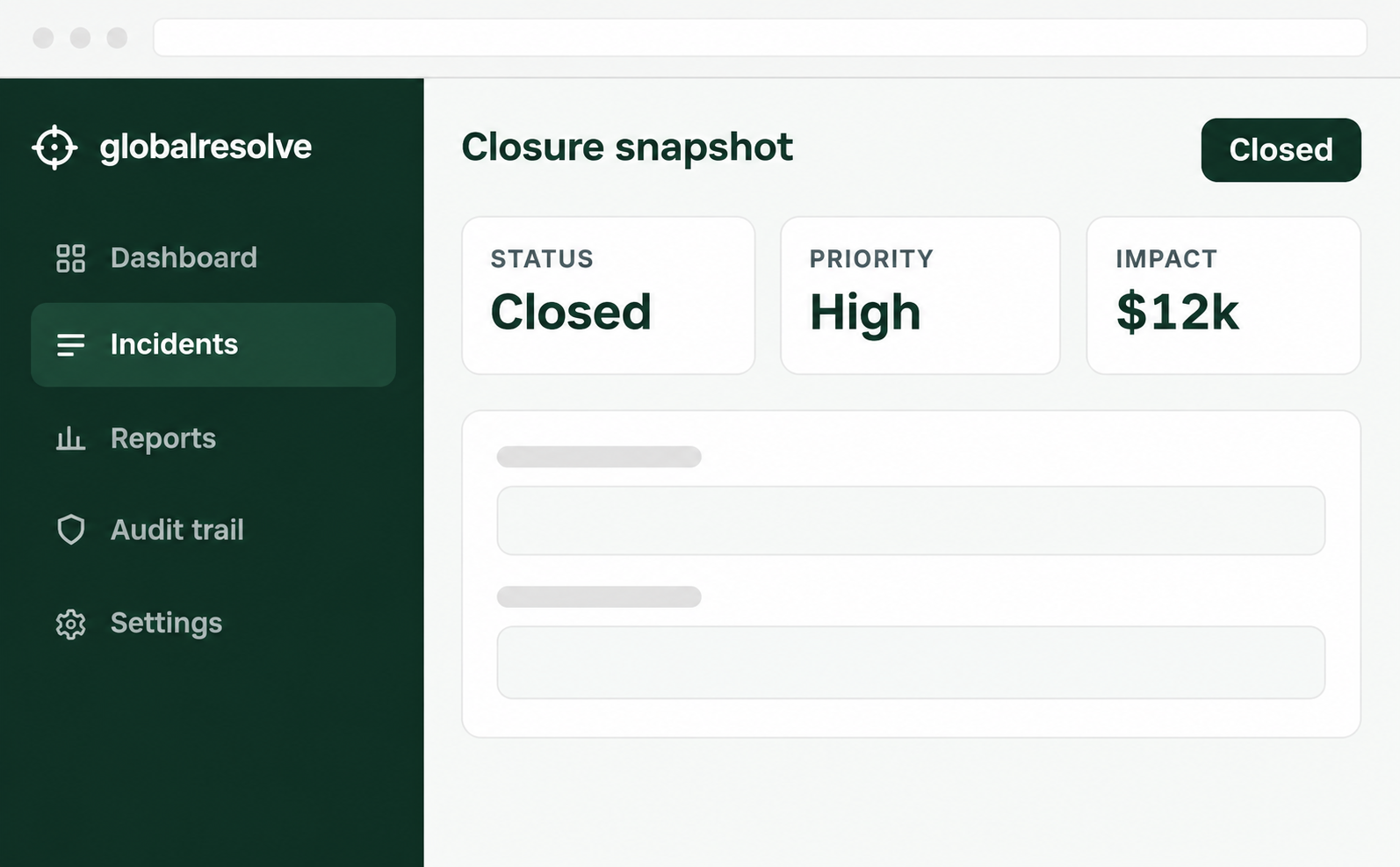
The one-page Closure Snapshot PDF attached to a closed incident.
Leadership and boards
Problems logged, owned and closed, rather than absorbed
In most small and mid-sized companies, the CEO hears about a problem when it is already expensive, and hears about the fix in a sentence: “we have dealt with it.” GlobalResolve replaces the sentence with a record, and the record with a monthly page: what went wrong, what it cost, who owns the fix, what is overdue, and whether the same category is still recurring.
The point is not surveillance. It is that a team logs problems when logging them leads to a fix rather than a blame conversation, and the six-step cycle gives them that. Leadership gets the risk mindset it keeps asking for because the tool makes the right behaviour the easy one: anyone can log, every action has an owner, nothing closes unverified, and the report shows the pattern.
WHAT LEADERSHIP SEES
- The monthly control report, scheduled, with matters for attention written by the person who runs the process.
- Loss by category over six months, so the conversation is about the pattern, not the latest incident.
- The by-owner table, which shows when one person is carrying too many open actions.
- Oversight access for directors and investors.
When companies start
Four moments when “show me how you handle issues” is about to be asked
Your first statutory audit
The auditor will ask what went wrong this year and what you did about it. Six months of incidents with verified actions is an answer. A folder of emails is a finding.
ISO 9001 or another certification
Clause 10.2 of ISO 9001:2015 asks for nonconformities, corrective actions and a review of their effectiveness, with records retained. That is the six steps, with the record kept for you.
Investor due diligence
A data room that includes an incident and loss register, with losses quantified and fixes verified, says more about management quality than any slide.
Use cases
The incidents that come up most, and what the fix looks like